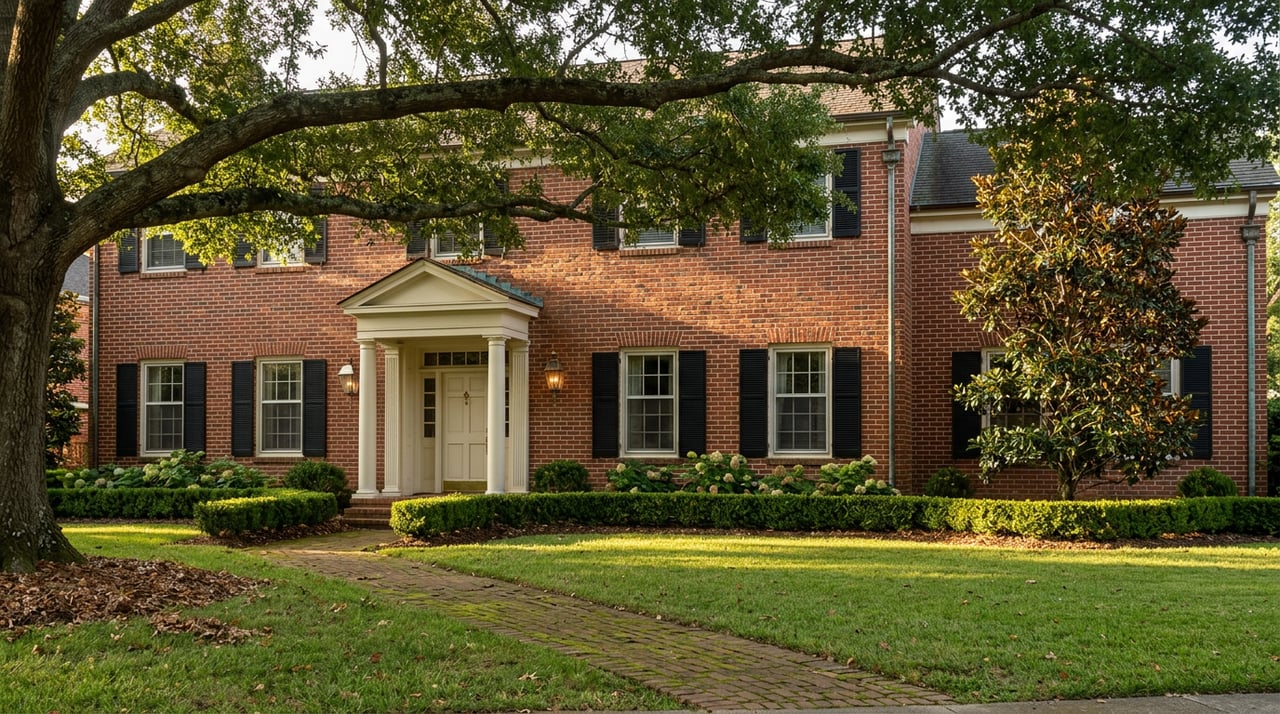
What does a hundred-year-old white oak add to the price of a Buckhead teardown lot? Before this year, the honest answer was: whatever the photos suggested. A canopy of mature hardwoods along West Paces Ferry or in the older sections of Chastain Park has always read as pure upside, the kind of detail an appraiser notes and a buyer falls for on the first walkthrough. Now, that answer requires a lot more than a walkthrough. It requires paperwork, and in some cases a permit is pulled before the lot ever hits the market, as Buckhead.com has reported.
Atlanta's Tree Protection Ordinance got its first major rewrite since 2001 last year, Fox 5 Atlanta reported; City Council passed it unanimously in June 2025, the AJC reported, and the fee changes took effect January 1, 2026, according to the City of Atlanta. For most of the city, the rewrite is background noise. For Buckhead, where large single-family lots and old-growth canopy define entire streets, it changes the math on nearly every teardown, addition, or major renovation project currently in motion.
What Actually Changed on January 1
The headline number is the recompense fee, the amount a property owner or builder pays the city per diameter inch of tree removed. The old formula was a flat $100 plus $30 per inch. The new formula strips out the base fee and sets a flat $140 per inch. Run that math on a mature specimen and the difference is not subtle.
| Before 2026 | Since January 1, 2026 | |
|---|---|---|
| Recompense formula | $100 base + $30/inch | $140/inch flat |
| Example: a 24-inch oak | About $820 | $3,360 |
| Illegal removal fine, per acre, as reported by Atlanta News First | $100,000 | $200,000 |
| Max recompense per acre, R-1/R-2 zoning | $10,000 | $35,000 |
The per-acre caps matter as much as the per-inch fee. R-1 and R-2 zoning, which covers a large share of Buckhead's single-family streets, now caps at $35,000 per acre, up from $10,000. For a builder assembling a multi-acre parcel for a subdivision, that cap is the number that decides whether the deal pencils. For a homeowner clearing a single backyard tree, the per-inch fee is the one that shows up on the invoice.
Why This Lands Harder in Buckhead Than Almost Anywhere Else in the City
According to Livable Buckhead, Buckhead is built almost entirely on R-1 through R-5 residential zoning, and its lots carry more contiguous canopy than the citywide average. As Buckhead.com reported, Trees Atlanta executive director Greg Levine said: "Buckhead has a higher tree canopy than the overall canopy for Atlanta." The report also noted that the neighborhood is losing trees at an unusually fast clip as large parcels get subdivided into smaller ones.
That combination, more canopy and faster loss, is exactly what the ordinance was written to slow down. It also means Buckhead property owners are more likely than almost anyone else in the city to actually hit these new numbers instead of reading about them in the abstract.
The Permit-First Play
The least obvious change in the new ordinance has nothing to do with fees. It has to do with who gets to decide what "necessary" tree removal looks like. Land use consultant Charlie Sears of Land Plus Associates flagged a provision inside that authority worth knowing before you make an offer on a wooded lot: the arborist can now require a project to reuse existing driveways, parking areas, or building footprints already on the site rather than clearing fresh ground.
That subjectivity is pushing some sellers of undeveloped or teardown-ready lots to do something they would not have bothered with a year ago: design and permit a home before listing the property at all. Rather than let a buyer guess whether the arborist's office will approve the clearing a new build needs, the seller absorbs that risk upfront and sells a lot with proof of buildability attached, sometimes called a placeholder permit. If you're evaluating a lot without one, the arborist's discretion is now part of your due diligence, not a formality you check off after closing.
What This Means If You're the One Buying the Lot
If you're under contract or close to it on a wooded Buckhead property, whether it's a full teardown or a renovation that touches the yard, a few documents are worth requesting before your due diligence period closes:
- A current tree survey identifying every tree
- Any tree removal permits already pulled on the property, along with the arborist's approval or denial notices
- A written arborist assessment if any trees have been marked as dead, dying, diseased, or hazardous
- Any documentation for tree work already completed on the property
Buyers' agents are increasingly walking wooded lots with an eye for what isn't there. A cut stump or a thin patch in an otherwise full canopy raises a fair question: was that tree removed with a permit, or without one? That question is a legitimate closing-table conversation rather than an awkward one.
The Number That Doesn't Show Up in the Listing Price
The ordinance also builds in a review timeline that's easy to miss until it's holding up your closing. According to the City of Atlanta, once a permit application is filed for a private tree, the city posts the property for a minimum of ten calendar days before making a preliminary decision, then posts again for five working days once preliminary approval is granted, allowing time for public appeal. That's not a fast process, and it doesn't move faster for a $4 million lot than it does for a $400,000 one. A buyer working on a tight timeline to break ground should build that review window into the contract rather than discover it after the fact.
None of this makes Buckhead's mature lots less desirable. If anything, the canopy that's harder to clear is the same canopy that gives these streets their character and their resale strength over time. What's changed is that the value of an old-growth lot is no longer something you can eyeball from the curb. It's something you document, price, and time correctly, and the sellers and buyers doing that work now are the ones avoiding a surprise at the closing table later.
FAQ
Does the new ordinance apply if I just want to remove one tree for a normal renovation, not a full teardown? Yes. The ordinance applies to tree removal on private property inside the City of Atlanta, whether the project is a full rebuild or a single addition.
What if the seller already removed trees before I made an offer? Ask for the permit and any arborist documentation.
Does this apply to my property if I'm in Brookhaven or Sandy Springs instead of Buckhead proper? No. The Tree Protection Ordinance is a City of Atlanta code. Brookhaven, Sandy Springs, and Dunwoody are separate municipalities with their own tree rules, which is worth confirming through each city's planning department if your search spans more than one jurisdiction.
If you're weighing a teardown lot, a major renovation, or a listing with mature trees anywhere in Buckhead, The Boyd Team can walk the property with you and help you time the paperwork correctly before you're locked into a contract. Request a Confidential Consultation to talk through your specific lot before you make an offer or set a list price.
This article is general information, not legal, tax or financial advice. Consult a qualified professional about your situation.